Duel Mines Review: 100% RTP Crypto Mines with 1-24 Mine Modes
Classic Minesweeper logic with a crypto-casino twist. Reveal safe tiles, avoid the bombs, cash out before you bust.
What is Duel Mines?
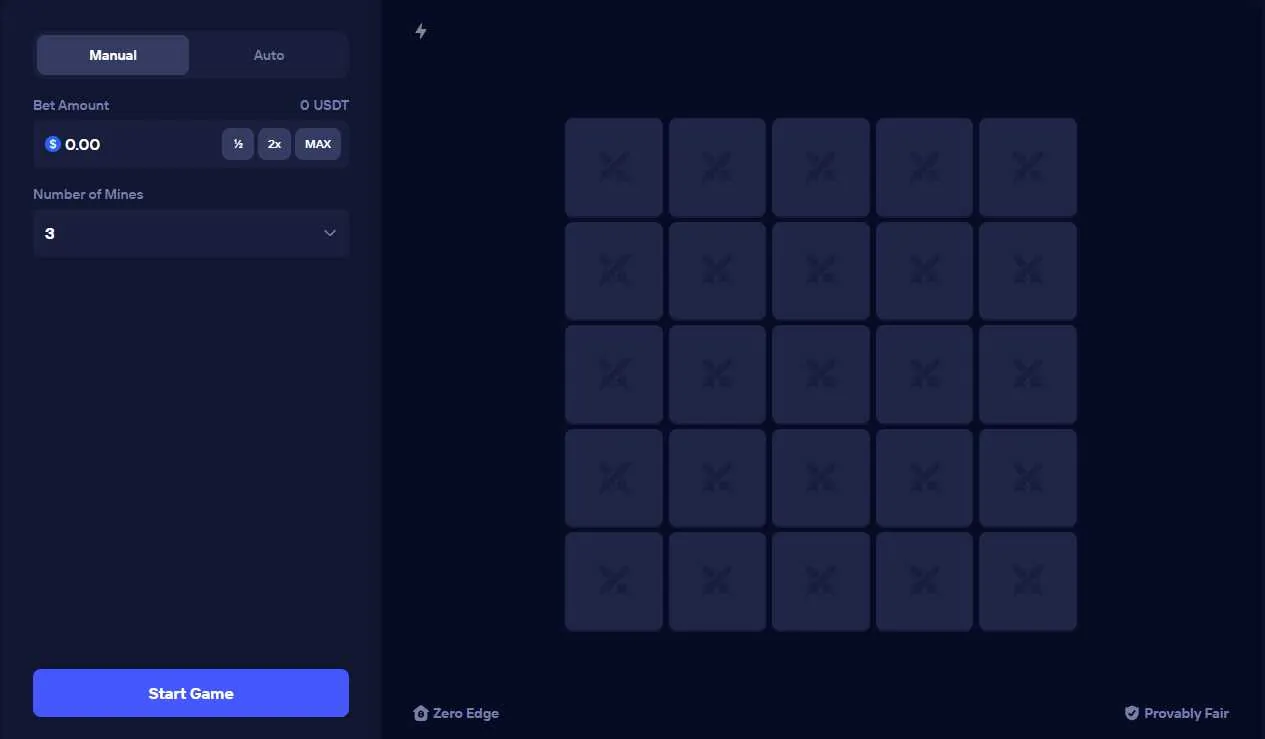
Mines uses a 5x5 grid with 25 tiles. Before each round you choose how many mines (1 to 24) are hidden under those tiles. The rest are safe. Tap a tile to reveal it. If it is safe, your multiplier increases. If it is a mine, you lose your wager.
You can cash out at any point. Your current multiplier x wager is paid out and the round ends. The decision is when to stop revealing, and the optimal stopping point depends on how many mines you chose and how greedy you are willing to be on a given round.
At Duel, the multiplier table is calibrated for 100% RTP on every mine count and every reveal depth. No house edge anywhere. This is structurally different from Stake Mines (1% edge), BC.Game Mines (1% edge), Roobet Mines (1% edge), Rollbit Mines (variable 1% to 2% by depth).
How does the multiplier formula actually work?
The multiplier formula at 100% RTP is purely combinatorial. For a board with M mines, after revealing k safe tiles, the multiplier is the inverse of the probability of revealing k safe tiles in a row given M mines distributed uniformly across 25 positions:
Multiplier(k) = C(25, k) / C(25 - M, k)
          where C is the combinatorial "choose" function.

          Equivalently:
          Multiplier(k) = product over i from 0 to k-1 of [(25 - i) / (25 - M - i)]
This is the cleanest possible multiplier formula. It directly reflects the probability of survival without any "edge factor" multiplied in. Other Mines variants in the category use Multiplier(k) = 0.99 x [C(25, k) / C(25 - M, k)], where the 0.99 is the house edge.
Concrete examples on Duel's 0%-edge formula:
- 3 mines, reveal 5 safe tiles: multiplier 2.04x. Probability of getting this far: 49%.
- 3 mines, reveal 10 safe tiles: multiplier 6.62x. Probability: 15.1%.
- 3 mines, reveal 20 safe tiles: multiplier 100x. Probability: 1%.
- 3 mines, reveal 22 safe tiles (all safe revealed): multiplier 230x. Probability: 0.43%.
- 10 mines, reveal 5 safe tiles: multiplier 8.18x. Probability: 12.2%.
- 10 mines, reveal 10 safe tiles: multiplier 89x. Probability: 1.12%.
- 24 mines, reveal 1 safe tile: multiplier 25x. Probability: 4%.
At every reveal, your probability of busting on the next tile times your potential multiplier gain equals 1.0. The casino keeps zero edge regardless of strategy.
How does Duel Mines compare to other crypto-casinos?
- Stake Mines: 1% house edge. Multiplier formula has 0.99 factor applied throughout.
- BC.Game Mines: 1% house edge. Identical formula structure to Stake.
- Roobet Mines: 1% house edge.
- Rollbit Mines: Variable edge by depth, 1% on shallow reveals, up to 2% on deep ones.
- Duel Mines: 0% house edge across all mine counts and all reveal depths. 5% Originals rakeback on busted rounds.
Across $1,000 wagered at 3-mine / 5-reveal target, the expected outcomes:
Stake Mines:        $990 expected return
          Stake Diamond:      $991.10 (11% VIP rakeback)
          BC.Game top tier:   $991.50 (15% rakeback)
          Duel Mines:         $1,000 + ~$2.55 rakeback on busted rounds
          Duel Mines net:     ~$1,002.55 positive EV
Duel is structurally the highest-RTP Mines product in crypto-casino, available from first wager with no VIP grind.
The Zero Edge daily cap on Mines (the nuance most reviewers skip)
Mines' 100% RTP across every mine count and reveal depth is honest, but it carries a structural limit per Duel's in-app Zero Edge banner (verified May 2026): zero house edge applies up to a $50,000 daily wager limit on Mines specifically, with a $1,000 single-bet limit. Once you exhaust the daily Mines cap, a 0.1% house edge applies (99.9% RTP) on Mines until the 24-hour reset.
For most Mines sessions this is invisible: $50K/day per game is far above recreational volume. The 99.9% post-cap RTP still beats every competitor's 99% Mines comfortably. And the cap is per game, so you can rotate to Crash, Dice or Plinko (each with its own $50K daily allotment) to stay at zero edge.
Strategy: balancing risk vs reward
- 1 to 3 mines, cash out at 5 to 10 reveals. Smooth variance, moderate multipliers (2x to 5x). Good for long sessions. Win rate around 60% per round.
- 5 to 10 mines, cash out at 3 to 5 reveals. Bigger multipliers (5x to 20x), more risk. Win rate around 35% to 50% per round.
- 20 to 24 mines, reveal 1 tile. Pure coin-flip for huge multipliers (15x to 25x). Win rate matches the safe-tile-to-grid ratio, around 4% to 20%.
- Stacking depth at moderate mine count: 5 mines, 15 reveals, multiplier around 33x. Survival probability around 7%. Best lottery-mode play if you want a real shot at a big hit.
The trap to avoid: getting greedy. The math says every additional reveal has the same risk-reward ratio at 100% RTP (probability of next bust times potential gain equals 1.0), but psychology says "one more tile" until you bust. Pick a cash-out target before clicking and stick to it. We have lost more on Mines than on any other Original by overrunning our chosen target.
The bankroll math for a smooth strategy
A standard "1.5x-target" Mines strategy with 3 mines:
Target multiplier:               1.5x
          Required safe reveals:           4
          Probability of 4 safe reveals:   ~67%
          Probability of busting before:   ~33%
          Average outcome per $1 wager:    $1.00 (100% RTP)

          Across 100 rounds at $10 stake:
          Wagered:                         $1,000
          Expected wins (67 of 100):       $1,005 (67 x 1.5 x $10)
          Expected losses (33 of 100):     $330
          Expected balance:                $1,005 - $330 + $0 (no net edge) = $1,000
          Rakeback on $330 losses (5%):    $16.50
          Net expected balance:            $1,016.50
Plays smooth, wins around 67% of rounds at 1.5x multiplier, loses around 33%. Sustainable for long sessions with modest positive expected value after rakeback.
A more aggressive strategy at 5x target on 3 mines:
Target multiplier:               5x
          Required safe reveals:           9
          Probability of 9 safe reveals:   ~21%
          Average outcome per $1 wager:    $1.00 (100% RTP)

          Across 100 rounds at $10 stake:
          Expected wins (21 of 100):       $1,050 (21 x 5 x $10)
          Expected losses (79 of 100):     $790
          Expected balance:                $1,050 - $790 + $740 (no edge) = $1,000
          Rakeback on $790 losses (5%):    $39.50
          Net expected balance:            $1,039.50
Higher variance, same expected value before rakeback. Higher absolute rakeback because more rounds bust.
Provably fair mechanics
Before each round, Duel commits to a hashed server seed. The mine positions are derived deterministically from server seed plus client seed plus nonce plus the order of your tile clicks. After the round, you can verify the mine positions were locked in before you started revealing, they do not shift based on your clicks.
This matters because it eliminates the suspicion that some casinos calibrate mine positions to your reveal pattern. At Duel, it is mathematically provable they cannot. The seeds are fixed at round start, the positions are derived from those seeds, and your reveal sequence just reveals tiles in the order you click, not in an order that changes positions.
You can audit any round with Duel's own built-in verifier: paste the seeds and it reproduces the same mine layout Duel did. If the layout matches the one you experienced, the round was deterministic and unmanipulated.
Common mistakes that cost real money
- "Hot tile" superstition, past safe tiles do not influence future probabilities. Each reveal is independent given the remaining unrevealed tiles. The corner that was safe last round has no memory.
- Cash-out drift, setting a target then mentally extending it after each successful reveal. The optimal pre-commitment is your friend. Write down the cash-out target before round 1 and stick to it through the session.
- Mine-count switching mid-session, all mine counts have identical EV. Switching is purely variance preference, not a way to "find a good streak."
- Edge-of-grid superstition, players who avoid corners or edges believing mines cluster there. Mines are distributed uniformly across the 25 positions; corners and centers have identical mine probability.
- "Last tile must be safe" reasoning, after revealing 5 safe tiles with 3 mines (20 unrevealed, 3 mines), the next tile is mined with 3/20 = 15% probability. There is no exhaustion effect; the probability of bust is what the remaining ratio is.
Rakeback on Mines worked example
5% rakeback applies to losing rounds (when you hit a mine before cashing out). This adds modest positive EV over time:
Mines session, 500 rounds at $10 average wager:
          Cumulative wager:               $5,000
          Bust rate at 1.5x target / 3 mines: 33%
          Lost wagers:                    500 x $10 x 33% = $1,650
          Rakeback (5%):                  $82.50 cash
          Net effective return:           $1,000 expected + $82.50 rakeback = $1,082.50
Combined with 100% RTP this nets a slightly positive expected return. The compounding pattern: aggressive strategies with high bust rates produce more rakeback in absolute terms; conservative strategies with low bust rates produce less rakeback but smoother variance.
Why a few hundred rounds won't settle the variance, without a funded test
We haven't logged a funded Mines session, so this is the math, not an observed result. At 3-mine / 5-reveal, the win probability per round works out to roughly 49%, and at 5-mine / 5-reveal roughly 24%, both figures derived from the reveal combinatorics rather than a house-set number. Because those are the true probabilities, a sample of only a few hundred rounds at either target can easily land noticeably above or below the expected win rate; that is normal variance, not evidence the game is running hot or cold. The rakeback layer adds a small, consistent positive EV on losing rounds regardless of target chosen, but it does not shrink session-level variance.
FAQ
Are the mine positions chosen before or after I click?
Can I auto-play Mines?
What is the highest multiplier possible?
Does Mines have a maximum profit cap?
Is there an optimal mine count?
Can I see the layout after the round if I cashed out early?
What happens after the $50K daily cap on Mines?
Where to go next
- All six Duel Originals, the full 100% RTP lineup.
- Duel Plinko, the visual variance product at 100% RTP.
- Duel Dice, the threshold-choice cousin at 100% RTP.
- Provably fair explained, how the seed commit-reveal scheme works.
- Rakeback math, how the 5% Originals rebate compounds.
- Duel vs Stake, full Mines and rakeback comparison.
18+. Mines variance compounds at deep-reveal targets. Play responsibly. BeGambleAware.