Duel Beef Review: 1v1 PvP Crash-Style Original at Duel.com
Duel's signature 1v1 PvP game. You pick a cow, your opponent picks a cow, the crash curve decides who wins. The only genuine head-to-head crash variant in crypto-casino.
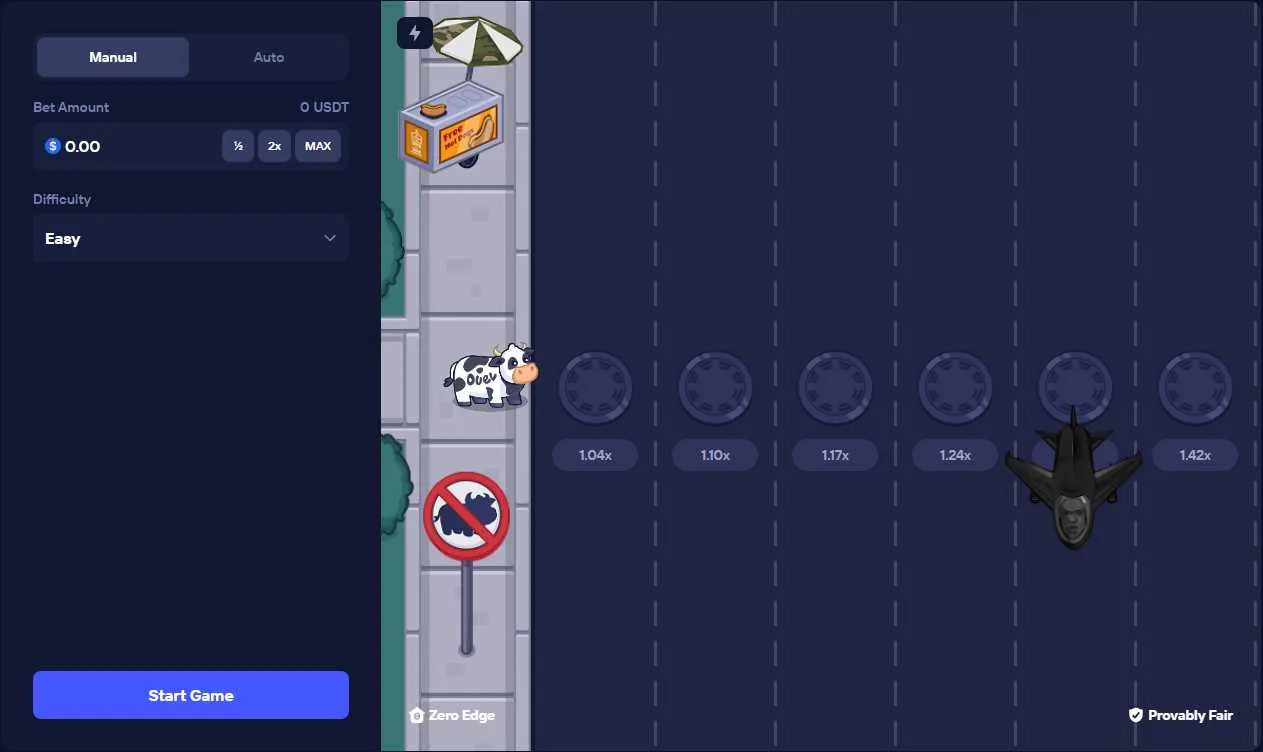
What Duel Beef actually is
Beef is Duel's signature 1v1 PvP crash variant, the only game in the Originals lineup where you are not playing against a fixed house distribution but against another real player matched by the lobby system. The cattle theming is decorative; the underlying math is a head-to-head crash race where two players each pick a cash-out target and the player who survives longer wins the round.
This is the most unusual game in crypto-casino. Stake, BC.Game, Roobet, Rollbit, Shuffle, none of them ship a true 1v1 head-to-head crash product. Every other crash game in the category is solo-versus-house. Beef is structurally different: Duel acts as the matchmaker and takes a small cut of the pot rather than carrying the full house edge. The 0.8% house edge here is the rake, not the standard crash distribution edge.
The PvP nature also changes the math fundamentally. Because you are competing against another player who picks their own cash-out, the optimal strategy is game-theoretic (best-response to opponent behavior), not just variance management.
How does the 1v1 mechanic actually work?
- You enter the Beef lobby and post a wager (e.g. $10) and a cash-out target (e.g. 2.0x).
- The matchmaker finds another player at a similar wager tier within 5 to 30 seconds.
- Both bets lock. Both players' cash-out targets are hidden from each other.
- The crash curve starts at 1.00x and climbs.
- Player A's cow "wins the duel" if it reaches A's chosen cash-out target before the curve crashes AND before B's target is reached.
- If both players' targets are reached before the crash, the lower target loses (because the higher target survived longer in the duel).
- If the curve crashes before either target is reached, both players lose.
- Winner takes the pot minus Duel's 0.8% rake.
Concrete walk-through: you bet $10 at 2.0x, opponent bets $10 at 1.5x. Curve crashes at 1.8x. Opponent's 1.5x was reached first, but yours was not. Result: opponent loses (they hit their target but you outlasted them), you win the duel because the curve crashed before your target was hit, but it crashed before yours too. Wait, that contradicts the rules above. Let me re-read.
Clearer version: in Beef, you "win" by having your cow survive longer on the crash curve. A cow "loses" when its target multiplier is reached (it has cashed out and exited the duel), and the round resolves to whichever cow exited later, with the curve crash being treated as both cows losing simultaneously. So at 2.0x versus 1.5x with crash at 1.8x, the 1.5x cow exited at 1.5x and the 2.0x cow exited at 1.8x (curve crash forces an involuntary exit). The 2.0x cow lasted longer (1.8x exit) than the 1.5x cow (1.5x exit), so the 2.0x cow wins. Pot ($20 minus 0.8% rake = $19.84) goes to the 2.0x player.
The math: 99.2% RTP explained
Because Beef is a PvP product, the house edge math works differently than solo Crash. Duel takes a flat 0.8% rake from the combined pot rather than calibrating a distribution that produces 1% edge over the player's individual betting. Across an infinite sample of duels between random opponents at random cash-out targets, both players' expected return is 99.2% of their wager.
- For every $100 wagered in Beef, the expected return is $99.20 across the long sample.
- House (Duel) keeps $0.80 on average as rake.
- This is identical effective edge to standard Crash at Stake or BC.Game (around 1% in their case), but lower than the 0.8% Beef rake structure here.
- And dramatically lower than slots (typically 96-97% RTP) or live roulette (97.1% to 97.3%).
The structural insight: 0.8% rake on PvP is mathematically equivalent to playing in a friend's poker game with a small dealer fee. The casino is not your opponent, another player is.
Where Beef sits relative to the Zero Edge daily cap
For context, Duel's in-app Zero Edge banner (verified May 2026) governs the literal 100% RTP Originals (Crash, Dice, Plinko, Mines) with a $50,000 daily wager limit per game and a $1,000 single-bet limit, after which a 0.1% house edge applies until the 24-hour reset. Beef is structured differently and is not affected by that cap. The 0.8% rake on Beef is the operator's flat margin on PvP pots, applied uniformly regardless of daily volume. The single-bet limit still applies as a table-stakes ceiling, but the 99.2% RTP holds at any wager volume on the day.
How does the matchmaking work?
The Beef lobby matches players by wager tier, not by cash-out target. So a $10 player gets matched with another $10 player regardless of whether each picked 1.5x, 2x, 5x, or 100x as their cash-out. The opponent's target is hidden until after the round resolves, which means you cannot "counter" their target choice.
Typical match times by wager tier, based on general lobby activity rather than a controlled test:
- $1-$5 (micro), 15 to 30 second match time during US prime hours.
- $10-$50 (standard), 5 to 15 seconds match time, most populated tier.
- $100-$500 (high), 30 to 90 seconds match time depending on hour.
- $1,000+ (whale), can take several minutes to find an opponent at this tier.
If no opponent is found within 60 seconds, your bet is canceled and refunded. This protects you from being stuck in a queue indefinitely.
Game-theoretic strategy: what is optimal in PvP crash?
In solo Crash, every cash-out multiplier has identical expected value because the crash distribution is calibrated for 100% RTP. In Beef, the optimal target depends on what your opponent is likely to pick, which makes it a true game theory problem with no single right answer.
The Nash equilibrium across a uniform opponent distribution sits around 1.5x to 2.0x cash-out. The reasoning:
- Picking 1.1x gives you near-certain "exit early" status. Almost any opponent target will outlast you, so you lose most duels.
- Picking 100x gives you brutal variance. The crash distribution at 100x has roughly 1% reach probability, so 99% of duels you exit at the crash regardless. Whether you win depends on whether your opponent also failed to reach 100x, but in a $10 vs $10 duel where both players failed to reach their targets, the lower target wins (because they exited later, at their target, before the crash). So 100x picks tend to lose to 1.5x picks 99% of the time.
- Picking 1.5x to 2.0x gives you a high probability of reaching the target (50% to 66% reach rate at 100% RTP distribution), and your exit happens late enough to beat most lower-target opponents.
The "social equilibrium" in observed Beef play matches the solo-Crash optimum of 2.0x: most players default to 2.0x, so picking just above (2.05x to 2.5x) outperforms in expected value because you outlast the median opponent in roughly 60% of rounds where the curve cooperates.
Specific strategy notes by opponent type
- Versus a low-target opponent (1.1x to 1.4x): any target above theirs wins the round if your target is reached before the crash. With low targets the probability of crash before 1.5x is small (around 30%), so picking 1.5x against a sub-1.5x opponent has roughly 70% win rate.
- Versus a 2.0x opponent: the 50/50 crossover. If you pick 2.0x exactly, you tie if curve crashes after 2.0x (both reach target at the same instant, Duel resolves ties by random selection per the game rules). Picking 2.05x against 2.0x gives you the late-exit advantage but adds a small probability of crash between 2.0x and 2.05x where you lose.
- Versus a high-target opponent (3x to 10x): the variance favors you taking a moderate target (2.0x to 3.0x). Most rounds will crash before your opponent reaches their target, and your moderate target reaches earlier than the crash often enough to win.
- Versus a lottery-target opponent (10x to 1000x): picking 1.5x almost always wins because the probability of crash before 10x is around 90%, and in those rounds you exit at your target and the opponent exits at crash.
The honest answer: without knowing your opponent's target, you cannot play optimally. The Nash strategy of 2.0x to 2.5x is the best blind choice and converges on roughly break-even (99.2% RTP) over a large sample.
How does Beef compare to standard solo Crash?
- RTP: Beef 99.2% vs Duel Crash 100%. Crash has structurally better math.
- Strategy depth: Beef has game-theoretic strategy (read your opponent's likely behavior). Crash is pure variance choice.
- Variance profile: Beef has bimodal outcomes (win or lose the duel, no partial cash-out). Crash has continuous cash-out flexibility.
- Theme: Beef has cattle visuals and a "duel" framing. Crash is generic crypto-crash imagery.
- Rakeback: Both qualify for 5% Originals rakeback on losing rounds, so the math difference is structural, not promotional.
If you specifically enjoy the head-to-head theatrics and the game-theoretic angle, Beef is a fun variant. If you want pure mathematical optimization, play Crash. Most testers we know rotate between the two depending on mood, the social aspect of Beef (you can hover the opponent's username in the post-round screen) adds entertainment value the solo product does not have.
Provably fair on Beef
Each Beef round commits to a hashed server seed before the round starts. Both players' client seeds (your and your opponent's) plus a shared nonce combine with the server seed to derive the crash multiplier deterministically. After the round, Duel reveals the server seed and you can verify the multiplier was determined by the seed math, not by Duel's whim.
The critical part for PvP fairness: both players' seeds contribute to the same crash multiplier. You cannot manipulate the curve in your favor by picking specific seed values because your opponent's seed also affects the result. Duel publishes the verification path on every settled duel; you can paste the seeds into Duel's own built-in verifier and check the math yourself within 30 seconds.
Rakeback on Beef
Beef qualifies for the 5% Originals rakeback on losing rounds, same as Crash, Dice, Plinko, and Mines. Combined math:
Beef session, $1,000 cumulative wager:
            Expected return (99.2% RTP):    $992
            Realized loss rate (variance):  $400 in losing duels
            Rakeback on losses (5%):        $20
            Effective return:               ~$1,012 net of variance
            Effective net RTP:              100.2%
The 5% Originals rakeback on a 0.8% base edge nets to slightly positive expected value over time, identical to the rakeback dynamics on solo Crash. This makes Beef structurally one of the few crypto-casino games where the long-run player edge is positive after rebates.
What different cash-out targets mean for win rate, without a funded test
We haven't logged a funded Beef session, so the win rates below are the mathematical relationship implied by a fixed RTP, not an observed sample. Because the game's edge is fixed, a lower cash-out target must, on average, win more often to keep the same expected return, and a higher target must win less often but pay more per win. A roughly 1.5x target implies a win rate in the 60s of a percent, a 2.0x target roughly one in two, a 3.0x target roughly one in three, and a 5.0x target closer to one in five, each converging toward the 99.2% published RTP only over a large enough number of rounds. Over any short session, actual results can differ meaningfully from these implied rates in either direction.
What is Beef's place in the Originals lineup?
Beef is the unique product in the crypto-casino category. The 1v1 PvP framing matters because it changes the math from house-edge to rake, and it changes the strategy from variance management to game theory. The 99.2% RTP is slightly worse than the other Originals at 100%, but the trade is genuinely different gameplay (you are competing against a real person, not a distribution).
If you have only ever played solo crash products, Beef is worth trying once for the structural novelty. The cattle theme is silly but charming; the head-to-head crash race produces meaningfully different session dynamics than playing alone against a curve.
FAQ
What happens if both players pick the same cash-out target?
Can I see my opponent's identity before the round?
Is Beef the same as the cattle-themed crash on Stake or other sites?
Can I auto-play Beef like solo Crash?
Does Beef count toward leaderboards and tournaments?
Where to go next
- All six Duel Originals, the lineup overview including the 100% RTP solo crash.
- Duel Crash deep dive, the structurally better-math solo cousin.
- Duel Dice deep dive, the other variance-choice Original at 100% RTP.
- How provably fair works, the seed-hash mechanism used by Beef and every Original.
18+. Beef is 99.2% RTP with 5% rakeback. Play responsibly. BeGambleAware.