Duel Crash Review: 100% RTP Crash Game with Provably Fair Math
The original 100% RTP Crash game. Cash out before the curve crashes, and Duel keeps nothing on the long run.
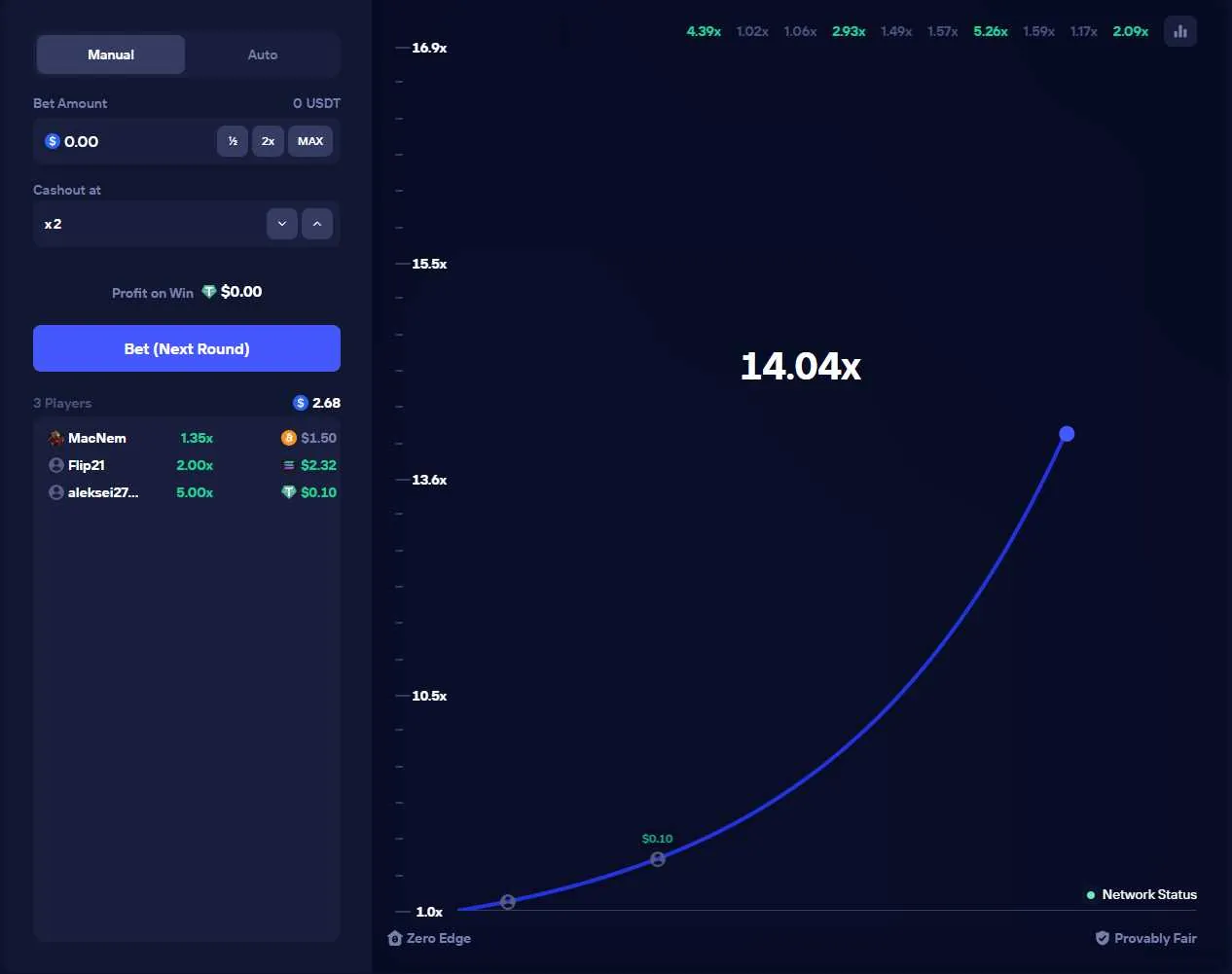
What is Duel Crash?
Crash is the simplest 100% RTP game in the Duel Originals lineup. The mechanic mirrors Stake's classic Crash, BC.Game's, Roobet's, and every other crypto-casino crash variant, but with one structural difference: zero house edge.
- You place a bet before the round starts.
- A multiplier curve starts at 1.00x and climbs in real time.
- At some unpredictable point, the curve "crashes," the round ends.
- If you cashed out before the crash, you win wager x cash-out multiplier.
- If you did not cash out in time, you lose the wager.
Duel's variant runs at literal 100% RTP, which means the long-run expected return equals exactly what you wagered. Below we explain how that is mathematically possible, what optimal play looks like, and how it compares to competitor crash products that run at 1% to 3% house edge.
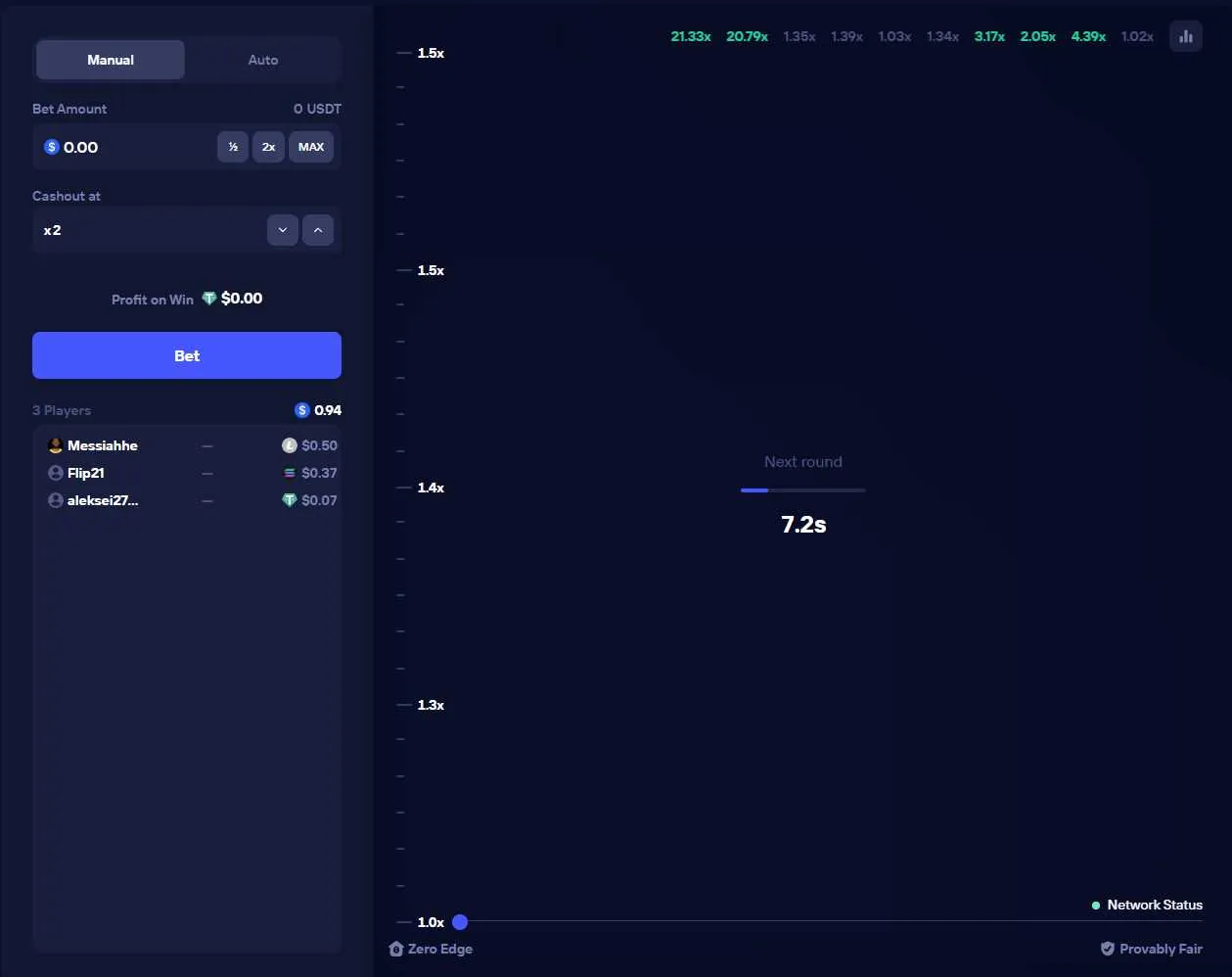
The math behind 100% RTP Crash
Standard Crash at Stake or similar runs with about 1% house edge. The crash distribution is calibrated so that the probability of the curve reaching a multiplier M is 0.99 / M, not the cleaner 1 / M. That 0.01 difference is the house's structural take.
Duel's version uses the clean 1 / M distribution, which means:
- Cashing out at 2.0x wins 2.0x your wager, but has only 50% probability.
- Cashing out at 10.0x wins 10x but has only 10% probability.
- Cashing out at 100x wins 100x but has 1% probability.
- Cashing out at 1.5x wins 1.5x with 66.67% probability.
- Cashing out at 1.01x wins 1.01x with 99.01% probability.
Multiply probability x payout in any of those rows: you get exactly 1.0. That is the 100% RTP. Every strategy has the same expected value (your wager itself). Strategy choice is purely about variance preference, not expected return.
For independent confirmation of the math, see provablyfair.com or the published distribution analysis on Wizard of Odds. The 1 / M distribution is mathematically the only way to achieve 100% RTP on a multiplicative crash mechanic; no other formula produces clean zero edge.
How does Duel Crash compare to crash at other crypto-casinos?
Direct comparison of crash mechanics at the top crypto-casinos:
- Stake Crash: 1% house edge. Published distribution uses 0.99 / M. Solo versus house, no PvP option. No rakeback on losses unless you reach Diamond VIP tier (~$2M wagered) for the 11% reward club rebate.
- BC.Game Crash: 1% house edge. Identical math to Stake. VIP rakeback up to 15% at top tier.
- Roobet Crash: 1% house edge. No rakeback at the casual tier.
- Rollbit Crash: 1% house edge. Different theme but identical distribution.
- Duel Crash: 0% house edge (true 100% RTP). 5% Originals rakeback on losses, available from first wager.
Across 1,000 cumulative wagered dollars at 2.0x cash-out target, the expected outcomes:
Stake Crash:        $990 returned ($10 house take, 0 rakeback)
          Stake VIP top tier: $991.10 returned ($10 house take, $1.10 rakeback at 11%)
          BC.Game (top VIP):  $991.50 returned ($10 take, $1.50 rakeback at 15%)
          Duel Crash:         $1,000 returned + $1.55 rakeback on lost rounds
          Duel Crash net:     ~$1,001.55 expected (positive EV)
Duel is the only crypto-casino crash product where the expected return is positive at every player tier. Other operators require VIP grind to approach break-even; Duel achieves it from the first bet.
The Zero Edge daily cap on Crash (the nuance most reviewers skip)
Crash's 100% RTP is honest, but it has a structural limit per Duel's in-app Zero Edge banner (verified May 2026): zero house edge applies up to a $50,000 daily wager limit on Crash specifically, with a $1,000 single-bet limit. Once you exhaust the daily Crash cap, a 0.1% house edge applies (99.9% RTP) on Crash until the 24-hour reset.
For most Crash players this is invisible: $50K/day in cumulative Crash wagers is well above casual or even semi-professional volume. If you do hit the cap, the 99.9% post-cap RTP still beats Stake's 99% Crash by a clear margin. And the cap is per game, so you can switch to Dice or Plinko (each with its own $50K daily allotment) and continue at zero edge. We disclose this because the headline number deserves the footnote.
Strategy: variance-balanced cash out
Since every cash-out multiplier has identical EV (your wager x 100%), the only thing strategy affects is how wild the variance feels:
- 1.01x to 1.25x cash out, near-certain tiny wins. Win 80% to 99% of rounds for sub-1.25x multipliers. Useful for tournament wagering volume.
- 1.5x to 2.0x cash out, gentle variance. Win 50% to 66.7% of rounds at moderate multipliers. Recommended for long sessions.
- 3x to 5x cash out, higher variance. Win 20% to 33.3% of rounds at meaningful multiples. Recommended for tournament position pushes.
- 10x+ cash out, lottery-grade variance. You will bust most rounds (90%+) but the wins are large enough to recover several losses each.
The pros at Stake-style Crash converged on 2.0x as the "social optimum": frequent enough wins to feel rewarding, low enough variance to avoid bankroll blowups. The same applies at Duel, but the 100% RTP means your converging EV stays at your wager rather than slowly bleeding to the 1% edge as it would on Stake.
Provably fair verification at Duel Crash
Each Crash round commits to a hashed server seed before the round starts. The SHA-256 hash of that seed is published immediately, which mathematically commits Duel to that specific seed (any change would produce a different hash). Your client seed plus a nonce (incrementing counter) combine with the server seed to derive the crash multiplier deterministically.
After the round, Duel reveals the server seed. You can run the SHA-256 hash yourself and confirm it matches the pre-committed hash. If it does, the result was not manipulated. Try this once with Duel's own built-in verifier (Account → Provably Fair → Verify Round): paste any past Crash round's seeds and confirm the multiplier was determined the moment the round started, not retrospectively.
The structural implication: even if Duel had a financial motive to retroactively pick worse-for-the-player multipliers, the seed commitment makes it mathematically impossible. The seeds are fixed before the round starts, and the multiplier derivation is deterministic. This is the same mechanism used by every audited provably-fair platform; Duel's docs page describes the implementation in technical detail.
Rakeback on Crash
Crash is an Original, so the 5% Originals rakeback applies to losing rounds. Combined with 100% RTP, this makes Crash slightly positive-expectation under casual variance:
Wagered $1,000 across 200 rounds at 2.0x cash-out.
          Expected return at 100% RTP:    $1,000
          Realized losses (variance):     $400 cumulative across losing rounds
          Realized wins (variance):       $400 cumulative across winning rounds
          Rakeback on losses (5%):        $20 (5% x $400)
          Final expected balance:         $1,020
          Effective net RTP:              102.0%
Modest, but genuinely positive. This is unique among crypto-casino crash products. Every other crash variant in the category nets to at best break-even at the highest VIP tier, and to a small loss at the casual tier. Duel's 5% rakeback applies from the first wager with no VIP grind required.
Auto-bet, Martingale, and what does not work
Duel's Crash has auto-bet with auto-cash-out. You can set a fixed cash-out multiplier (e.g. 2.0x) and let rounds run hands-off, with optional stop-loss and stop-win triggers.
Do not chase losses with auto-bet Martingale. Martingale (double stake after each loss) feels like it cannot fail, but with variance running long, sequences of losses are mathematically certain. Auto-Martingaling at 2.0x cash out: 7 losses in a row has probability ~0.78%, which sounds rare until you realize at 1 round per 8 seconds you accumulate 450 rounds per hour, so a 7-loss streak hits roughly every 9 hours of play. Recovering from 7 losses requires a 128x bankroll, which is brutal at any starting stake.
Other failing strategies:
- Anti-Martingale (double after wins), still fails because eventual losses wipe out everything you built up.
- Fibonacci progression, soft Martingale variant. Same exponential-bankroll problem during long streaks.
- "Cash out before X% of recent rounds" heuristics, every round is independent. Past results do not affect future probabilities.
- "Bot detection" pattern reading, the seeded RNG produces patterns that look like clusters, but they are statistical noise. You cannot reliably predict the next crash.
The honest strategy: flat-bet auto-cash-out at 2.0x is the cleanest long-run play. Set the stop-loss to a session-budget limit and walk when you hit it.
What does the math predict over 500 rounds, at $5 flat?
We do not run funded test sessions and cannot publish real-money play logs. What follows is arithmetic on the published mechanic (P(win) = 1/target multiplier for a 0%-edge inverse-multiplier crash), not a record of an actual session.
At a $5 flat stake for 250 rounds auto-cashed at 2.0x, the theoretical win rate is 1/2.0 = 50%: about 125 wins returning $1,250 against $1,250 wagered, break-even before rakeback. At 1.5x for 250 rounds, the theoretical win rate is 1/1.5 = 66.7%: about 167 wins returning roughly $1,251 against $1,250 wagered, also break-even before rakeback. Any real 250-round sample will deviate from these figures due to variance; only a much larger sample converges on them.
Rakeback is the one component that is not a coin flip: Duel pays 5% of Originals losses as cash, wager-free. On $2,500 cumulative wager split across both targets, losses run close to half the wager before cashout luck, so rakeback on that loss volume lands in the same range regardless of which 250-round sample you happen to draw. That's the part of Crash's value case that doesn't depend on variance working in your favor.
FAQ
Is Duel Crash really 100% RTP?
What is the optimal cash-out multiplier?
Can I lose money even at 100% RTP?
Does the 5% rakeback on Originals apply to Crash?
Is auto-bet allowed?
What is the maximum multiplier in Duel Crash?
What happens after the $50K daily cap on Crash?
Where to go next
- All six Duel Originals, the rest of the 100% RTP lineup.
- Duel Dice, the variance-choice cousin with the same 100% RTP math.
- Duel Beef, the unique 1v1 PvP crash variant.
- Provably fair explained, how the seed commit-reveal scheme works.
- Rakeback math, how the 5% Originals rebate compounds.
- Duel vs Stake, full crash and rakeback comparison.
18+. Crash is high variance even at 100% RTP. Play responsibly. BeGambleAware.