Duel Dice Review: 100% RTP Provably Fair Crypto Dice Game
The cleanest 100% RTP Dice game in crypto-casino. Set your win probability, roll, get paid at fair odds.
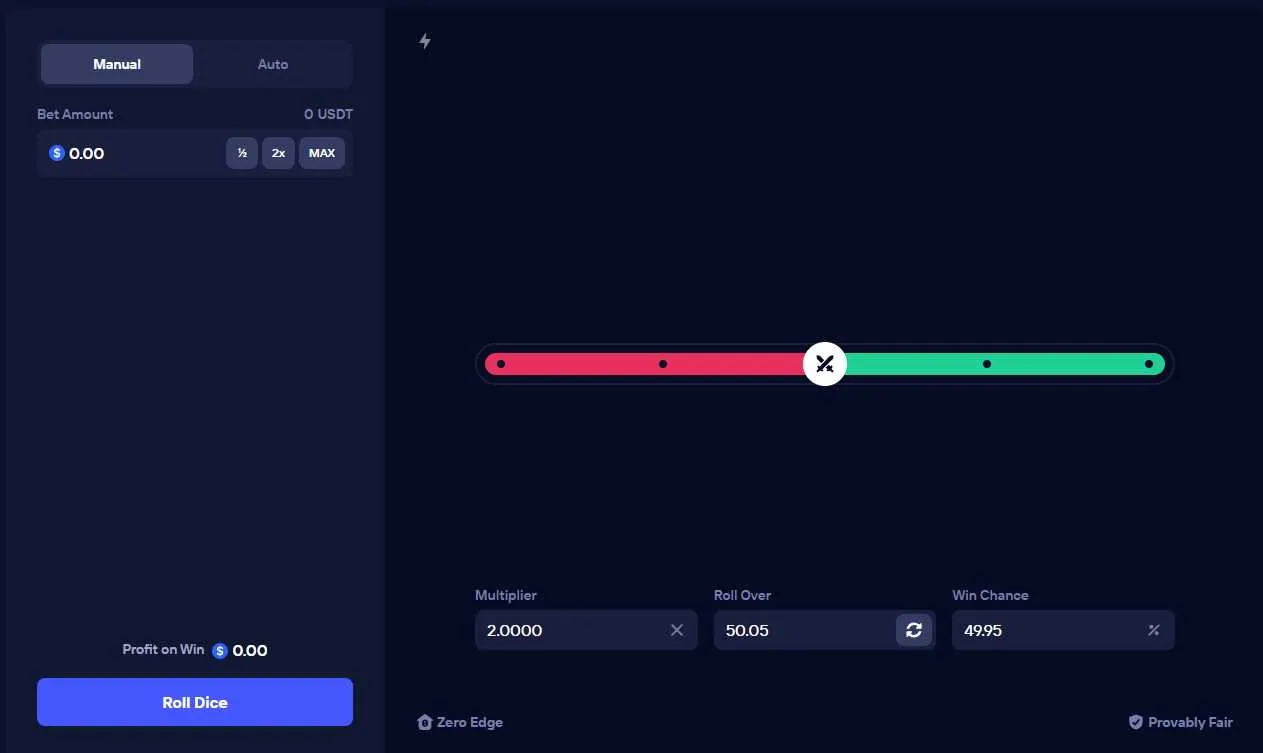
What is Duel Dice?
Dice is the most flexible Original at Duel: you control the win probability and the corresponding payout multiplier directly. There is no random house take applied to your payout. At 100% RTP, your payout is always exactly the fair odds for your chosen probability.
The mechanic:
- Choose roll-under or roll-over, plus a threshold (e.g. roll under 49.5).
- The threshold sets your win probability (e.g. 49.5%).
- Place your bet.
- A random number between 0 and 99.99 is generated provably fairly.
- If it falls in your chosen range, you win wager x payout multiplier.
This is the most transparent crypto-casino game in existence. You can see your own EV at every threshold, the math is verifiable, and the seeds are auditable. Every other Dice variant in the category (Stake, BC.Game, Roobet, Rollbit, Bitstarz) runs at 1% house edge; Duel runs at 0%.
The math: payout x probability = 1.00 always
The defining property of 100% RTP Dice is that win probability times payout multiplier always equals 1.0. Examples:
- 49.5% win chance, 2.02x payout (49.5% x 2.02 = 1.0)
- 33.33% win chance, 3.0x payout
- 10% win chance, 10.0x payout
- 5% win chance, 20.0x payout
- 1% win chance, 100x payout
- 0.01% win chance, 10,000x payout
- 0.0001% win chance, 1,000,000x payout (theoretical, capped by Duel's per-round liability)
At any threshold you choose, the expected return per wagered dollar is exactly $1.00. The casino keeps nothing. Multiply any probability by its corresponding payout and you get 1.0, that is the entire mathematical structure of the game.
This is mathematically identical to placing fair-odds bets in a friend's poker game: no house, no edge. The variance changes dramatically based on which threshold you pick, but EV is constant.
How does Dice at Duel compare to other crypto-casinos?
Direct comparison across the top crypto-casino dice products:
- Stake Dice: 1% house edge. Payouts are 0.99 / probability rather than 1.0 / probability. VIP top-tier rakeback (~11%) reduces effective edge to roughly 0.89%.
- BC.Game Dice: 1% house edge. VIP top-tier rakeback (~15%) reduces effective edge to 0.85%.
- Roobet Dice: 1% house edge. No rakeback at casual tier.
- Rollbit Dice: 1% house edge. Variable rakeback by tier.
- Duel Dice: 0% house edge. 5% Originals rakeback on losses, from first wager.
Across $1,000 wagered at 49.5% / 2.02x target, the expected outcomes:
Stake Dice:        $990 expected return (zero rakeback)
          Stake Diamond:     $991.10 (11% VIP rakeback)
          BC.Game top tier:  $991.50 (15% VIP rakeback)
          Duel Dice:         $1,000 expected + $2.50 rakeback
          Duel Dice net:     $1,002.50 expected (positive EV)
Duel is the only crypto-casino dice product with positive expected value at any player tier. Other operators require VIP grind to approach break-even.
The Zero Edge daily cap on Dice (the nuance most reviewers skip)
Dice's 100% RTP is honest, but it has a structural limit per Duel's in-app Zero Edge banner (verified May 2026): zero house edge applies up to a $50,000 daily wager limit on Dice specifically, with a $1,000 single-bet limit. Once you exhaust the daily Dice cap, a 0.1% house edge applies (99.9% RTP) on Dice until the 24-hour reset.
For typical Dice play this is invisible, $50K/day in Dice wagers is far above recreational volume. High-volume auto-bet sessions at low-multiplier targets (1.01x to 1.5x) can approach the cap faster than you might expect because of the high turnover rate. The 99.9% post-cap RTP still beats every competitor's 99% Dice. And the cap is per game, so you can rotate to Crash, Plinko or Mines (each with its own $50K daily allotment) to stay at zero edge.
Strategy by threshold
- 45% to 50% win chance (around 2x payout), coin-flip variance. Roughly even wins and losses. Smoothest experience for long sessions.
- 20% to 25% win chance (around 4x to 5x payout), moderate variance. Suitable for shorter sessions where you want bigger wins.
- 5% to 10% win chance (around 10x to 20x payout), high variance. Long dry streaks, but reasonable wins when they hit.
- 1% or lower win chance (100x+ payout), lottery variance. Most rounds lose, occasional huge wins. Best for tournament position-pushing where you need a single spike.
The 50/50 threshold is most popular for sessions. The high-multiplier modes are mostly used for tournament leaderboard pushes (fewer rounds, larger swings, single hits can move you up the leaderboard).
One nuance worth knowing: the variance gets dramatically harder at low win percentages. A 1% win chance means 100 losing rolls between wins on average, and at $1 per roll that is $99 in cumulative losses before the $100 win lands you back at expected break-even. The variance distribution has a heavy tail, you can easily go 300 rolls without a win at 1% probability, which is a $300 drawdown before the math catches up. Bankroll accordingly.
Provably fair Dice: how to verify yourself
Before each round, Duel commits to a hashed server seed. Your client seed plus a nonce derive a deterministic random number between 0 and 99.99. After the round, the server seed is revealed and you can rerun the SHA-256 calculation yourself to confirm the hash matches the commit.
Crucially: because every roll is deterministic from the seeds, Duel cannot retroactively alter outcomes. Your client seed gives you control. Set it to whatever you want before a session, and Duel is committed to derive outcomes from your seed plus the server seed plus the nonce counter.
The structural implication: if you suspect a roll was unfair, you can verify it within 30 seconds using Duel's own built-in verifier. Paste the seeds, it runs the same algorithm Duel uses, and you see the same random number. There is no daylight between "house result" and "your verifiable result" because both are produced by the same deterministic math.
Strategies that DO NOT work
- Martingale on Dice, same problem as in Crash. Doubling stakes after losses requires exponentially growing bankroll. Long loss streaks are mathematically inevitable. A 10-loss streak at 49.5% probability has 0.1% chance per session, which sounds rare until you play for hours.
- "Hot streak" chasing, at 100% RTP with deterministic seeds, past results do not influence future ones. Streaks are pure variance. The next roll has the same probability as the first roll, regardless of what came before.
- Threshold switching to "find a working level", every threshold has identical EV. Switching is purely psychological. The 1% / 100x setup has the same expected return as the 50% / 2x setup, with dramatically different variance.
- Pattern-reading on the seed-derived RNG, the deterministic seed produces a sequence that looks like clusters and streaks to human eyes, but those are statistical noise. You cannot reliably predict the next roll from past rolls.
- "Anti-martingale" (double after wins), eventually loses everything in a single bust. The math is symmetric to Martingale and fails for the same reason.
Flat-betting at your preferred variance threshold is the cleanest strategy. Do not overthink it. The math is fair at every threshold, and the 5% rakeback on losses adds a small positive nudge from the casino paying you back when you lose.
Rakeback on Dice and the worked example
As an Original, Dice qualifies for 5% rakeback on losing rounds. Combined with 100% RTP this makes Dice marginally positive-EV over time.
Example: $5,000 wagered at 49.5% / 2.02x target
          Expected EV (100% RTP):         $5,000 return
          Expected losses (50.5% of rounds): $2,500 in losing rounds
          Rakeback on losses (5%):           $125 cash
          Net expected balance:              $5,125
          Effective net RTP:                 102.5%
Quick check at lower-probability play:
Example: $5,000 wagered at 5% / 20x target
          Expected EV (100% RTP):         $5,000 return
          Expected losses (95% of rounds): $4,750 in losing rounds
          Rakeback on losses (5%):           $237.50 cash
          Net expected balance:              $5,237.50
          Effective net RTP:                 104.75%
The interesting insight: rakeback compounds more at lower win-probability thresholds because more of your wager flows through losing rounds and triggers the rebate. At 5% / 20x play, the effective RTP after rakeback works out to 104.75%, a rare structural case where the published math favors the player. Variance is brutal at that threshold, but the math is genuinely in your favor.
What win rate to expect at different targets, without a funded test
We haven't logged a funded dice session, so treat this as the math, not an observed result. At a 100% RTP game like Duel Dice, the win probability you choose is the win rate you should expect to converge toward over a large enough sample, a 49.5% / 2.02x target should land close to 254 wins per 500 rolls, and a 10% / 10x target close to 50 wins per 500 rolls, but any individual short sample can land noticeably above or below that, and past rolls have no bearing on future ones.
FAQ
Can I set my own client seed?
What is the highest multiplier I can play at?
Does Duel run different Dice variants?
Is there a maximum bet?
Do leaderboards count Dice wagers?
Can I auto-roll Dice?
What happens after the $50K daily cap on Dice?
Where to go next
- All six Duel Originals, the full 100% RTP lineup.
- Duel Crash, the continuous-curve cousin at 100% RTP.
- Duel Plinko, the visual variance product at 100% RTP.
- Provably fair explained, how the seed commit-reveal scheme works.
- Rakeback math, full breakdown of how 5% on Originals compounds with 100% RTP.
- Duel vs Stake, full dice and rakeback comparison.
18+. Dice variance compounds at low-probability thresholds. Play responsibly. BeGambleAware.