Duel.com KYC policy, full breakdown
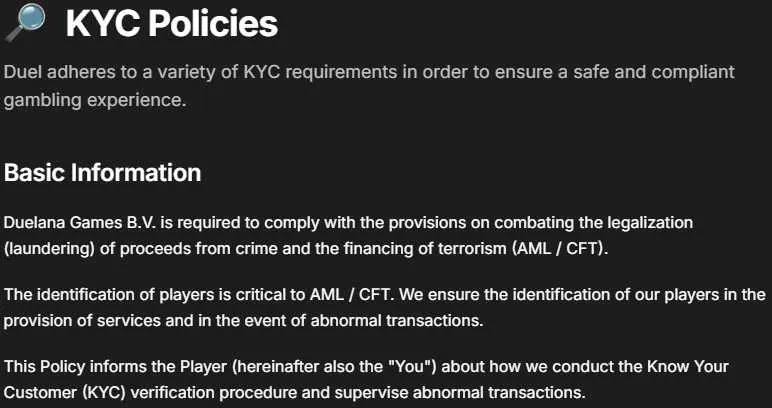
Duel.com does not require Know-Your-Customer verification for standard play. This page explains exactly when KYC triggers, what documents you need to provide if asked, and the practical limits of the no-KYC promise.
We may receive a commission for purchases made through affiliate links on this site. Our ratings and opinions remain independent.
The short answer: no KYC at standard play
You can sign up at Duel.com with just an email and password. You can deposit cryptocurrency, play any game, and withdraw winnings without ever uploading identification documents, under normal circumstances. This is the deliberate operational position of the brand and it is what most players experience.
However, "no KYC" has limits. There are four specific scenarios where Duel will request verification. Knowing these in advance prevents surprises later.
When does Duel.com request KYC?
From Duel's public documentation, KYC requests trigger on:
- Suspected underage play. If account behavior or stated information suggests the player is under 18, Duel will require ID verification before further play.
- Suspected rules violation. Bonus abuse, multi-accounting, VPN circumvention from restricted countries, payment-method fraud, all trigger KYC review.
- Large withdrawal AML review. Withdrawals above approximately $5,000 single or $10,000 cumulative within 24 hours may trigger automated AML review, which can request KYC.
- Sanctions or risk flags. If your deposit address is associated with sanctioned entities or known mixers, KYC may be requested before withdrawal.
None of these trigger on routine play with standard deposit and wager amounts. The vast majority of Duel players will never see a KYC request.
What documents are required if asked?
Duel's KYC procedure follows standard offshore operator practice:
- Photo ID: passport, driver's licence, or national ID card. Must be valid and clearly photographed (no glare, all corners visible, all text readable).
- Proof of address: utility bill, bank statement, or government correspondence dated within the last 90 days. Must show your full name and address matching your Duel account.
- Source of funds (for very large withdrawals only): bank statements, employer letter, or investment account statements showing the origin of the deposit funds. Typically only requested above $50,000 cumulative withdrawals.
Once submitted documents are approved, your account is cleared at that verification level. Future withdrawals at the same scale do not re-trigger verification. You only re-verify if your circumstances change (e.g., new address) or if Duel's AML team flags something new.
How long does KYC review take?
Typical processing times based on public reports, we don't have our own KYC timing data to compare:
- Standard ID + proof of address: 1–24 hours for review and approval.
- Complex cases (source of funds, multiple documents, manual review): 1–3 business days.
- Disputed cases (suspected fraud, conflicting documents): up to a week.
Your account is typically not frozen during KYC review, only the specific pending withdrawal pauses. You can continue depositing and playing normally while documents are reviewed.
Privacy and document storage
Duel's privacy policy states that KYC documents are stored encrypted and accessed only by authorized AML compliance staff. Documents are retained for the regulatory minimum period (typically 5 years) after account closure to comply with AML record-keeping requirements.
For high-privacy users, this is a meaningful disclosure: even at no-KYC operators, once you have triggered KYC once, your documents are on file. If document retention is a concern, the practical guidance is: keep your play volume below KYC trigger thresholds, and withdraw regularly rather than allowing large balances to accumulate.
For the technical side of how documents are stored (SSL, 2FA, account security best practices), see our security analysis.
How no-KYC at Duel compares to other operators
| Operator | Standard play KYC | Withdrawal KYC threshold |
|---|---|---|
| Duel.com | No | ~$5K single / $10K daily |
| Stake.com | Tiered | Tier-dependent (Level 2 for higher limits) |
| BC.Game | Tiered | Tier-dependent |
| Roobet | Sometimes | ~$500 |
| Rollbit | No | Variable |
| Bitstarz | Standard EU AML | ~$2K typically |
| UKGC operators | Mandatory pre-play | Pre-play verification required |
Duel sits at the most permissive end of the spectrum for no-KYC standard play. UKGC-licensed operators sit at the most strict end. Crypto-only operators tend toward less KYC than fiat operators.
The honest limits of no-KYC
- "No KYC" does not mean anonymous. Duel knows your IP address, deposit addresses, withdrawal addresses, and account behavior. These can be cross-referenced with on-chain analysis.
- If law enforcement subpoenas data, Duel will comply with valid legal requests as required by Anjouan licensing terms.
- Crypto withdrawals to your own wallet are not anonymous, chain analysis can connect them to your real identity if you have ever used a KYC'd exchange.
- No-KYC is about operator convenience, not about hiding from authorities. If you live in a country where gambling is illegal, no-KYC does not protect you from local law.