Provably fair at Duel.com, the math you can verify yourself
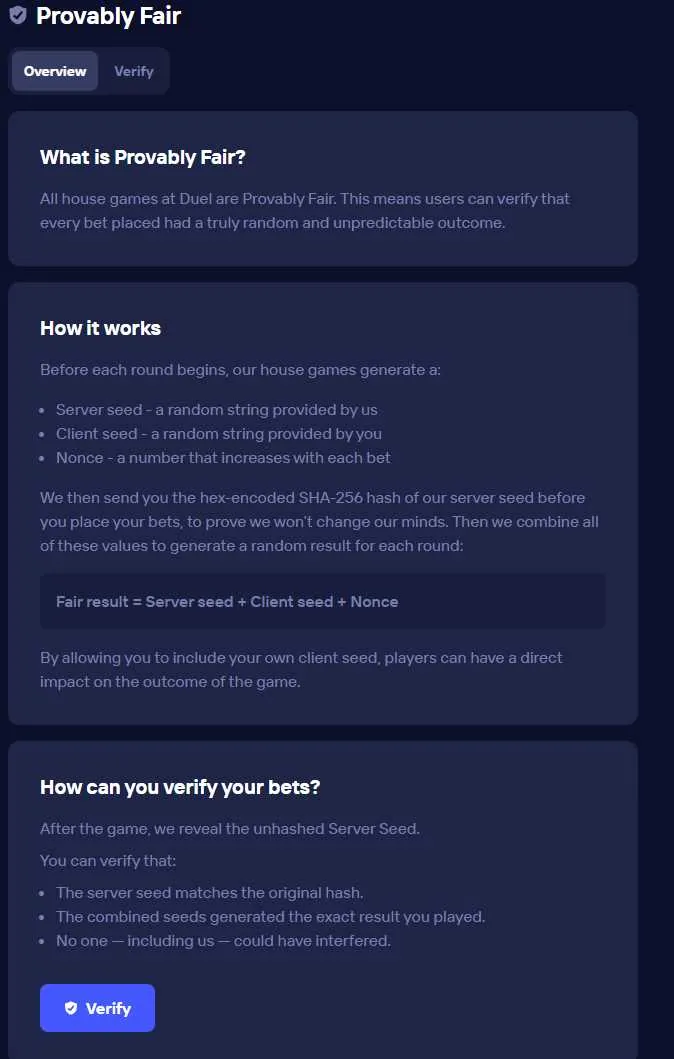
Duel claims literal 100% RTP on five of its six Originals. Provably fair is the mechanism that lets you verify that claim independently, round by round. Here is exactly how it works.
We may receive a commission for purchases made through affiliate links on this site. Our ratings and opinions remain independent.
What does provably fair actually mean?
Provably fair is a cryptographic technique that lets players verify each game round was determined fairly and was not retroactively manipulated. The mechanism uses three components: a server seed (chosen by the casino), a client seed (chosen by you), and a nonce (a counter that increments each round).
The casino commits to the server seed in advance by publishing its SHA-256 hash. Once published, the casino cannot change the seed without producing a different hash, making manipulation detectable.
After the round, the casino reveals the server seed. You hash it yourself and confirm it matches the pre-committed hash. If it does, the round result was determined the moment the seeds were set, not retroactively to hurt you.
The four-step verification process
- Pre-commitment. Before any rounds, Duel generates a server seed (random 256-bit value) and publishes its SHA-256 hash. Example hash:
a8b3c1d4e5f6.... The hash is public. The seed itself is hidden until reveal. - Client contribution. You set your client seed in Account → Provably Fair. Default is a random string Duel generates; you can replace it with any value (e.g., "my-client-seed-may-2026"). Your client seed is locked in for all subsequent rounds until you change it.
- Round derivation. Each round, Duel combines: server seed + client seed + nonce (the round counter, increments from 0 each session) → SHA-256 → maps to game outcome through a published algorithm. The outcome is deterministic, same inputs always produce same output.
- Post-round verification. When you finish a session (or any time you want to verify), you reveal the server seed (Duel cycles to a new seed for next session). You can now hash the revealed server seed yourself, compare to the published hash, and re-run the outcome derivation to confirm the result was determined by the seeds, not by Duel choosing a result that hurts you.
Why does this matter mathematically?
Without provably fair, "100% RTP" is an unverifiable claim. The casino could:
- Choose outcomes to reduce house cost when high-stake bets are placed.
- Tilt the distribution toward losses for high-volume players.
- Manipulate variance to extract more from streaky players.
With provably fair, none of those are possible without producing a hash that does not match the pre-commitment. Manipulation is mathematically detectable.
For Duel's 100% RTP Originals (Crash, Dice, Plinko, Mines, Blackjack effective), this means the published distribution is the actual distribution. Over a large sample, your expected return is your wager. Variance still exists round-to-round, but expectation is honest.
How to verify your own Duel rounds
Duel's built-in verifier. Account → Provably Fair → Verify Round. Paste the round's server seed, client seed, and nonce. The tool replays the derivation and shows whether the result matches.
If you don't want to rely on Duel's own verifier code, the SHA-256 commit-reveal scheme is public and standard. Any SHA-256 implementation, including free open-source ones, will re-derive the same hash from the same seed and nonce. You are not locked into trusting Duel's tool to check the math yourself.
What "verifiable" actually means here
We haven't run and logged a funded multi-round test session ourselves, so we won't claim a specific pass rate or win/loss tally we didn't measure. What we can say is structural: the SHA-256 commit-reveal scheme means any single round's outcome can be independently re-derived from the revealed server seed, client seed, and nonce, through Duel's own verifier, and the math either matches or it doesn't. That's what "provably fair" buys you, a checkable derivation, not a guarantee about your session's win rate, which is still governed by the game's published odds and ordinary variance.
Which Duel games are provably fair?
All six Duel Originals are provably fair: Crash, Dice, Plinko, Mines, Duel Blackjack, Beef.
Third-party slots (Pragmatic Play, NetEnt, Hacksaw, Nolimit City, etc.) are NOT provably fair through Duel's seed system, they use the slot provider's RNG, which is certified by third-party labs (typically iTech Labs or GLI) but not verifiable round-by-round.
Live casino (Evolution Gaming, Pragmatic Play Live) tables use physical equipment streamed in real time. Not provably fair in the cryptographic sense, fair via direct observation.
Common provably fair questions
"What stops Duel from showing me a fake server seed at reveal?" The hash was published before the round. If they show a fake seed, hashing it produces a different output than the pre-committed hash. Detection is automatic.
"What stops Duel from running multiple server seeds and choosing the worst-for-me one?" The hash commits to one specific seed value. They cannot run alternative seeds without publishing alternative hashes, which players would notice immediately.
"What stops Duel from manipulating the outcome derivation algorithm?" The algorithm is published. Independent verifiers (including ours) implement the same algorithm. If Duel's algorithm produced different results from public implementations, players would catch it.
"What if Duel changes the algorithm without telling me?" Algorithm changes would require a public announcement and a switch period. Hidden changes would produce diverging verification results between Duel and independent verifiers, again detectable.