Duel.com payments, full crypto guide
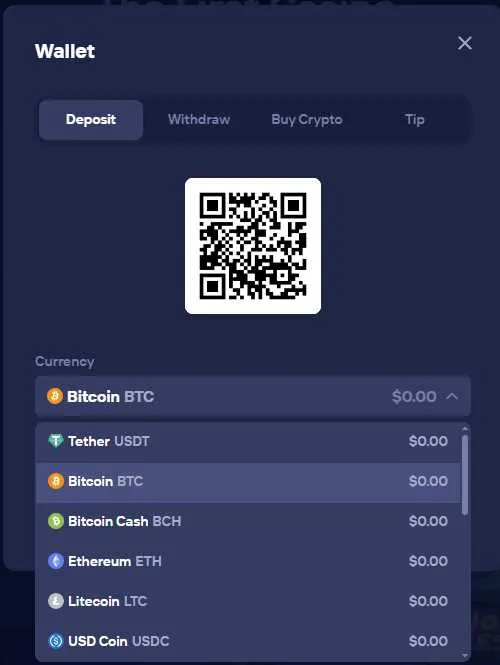
19 cryptocurrencies, $10 minimum, no platform fees, median withdrawal under 3 minutes. The complete network-by-network breakdown.
We may receive a commission for purchases made through affiliate links on this site. Our ratings and opinions remain independent.
The honest summary
Duel.com is crypto-only. There are no direct fiat deposits, no credit card, no SEPA, no Apple/Google Pay. If you don't already hold cryptocurrency, you'll need to buy some first (Swapped is integrated as a third-party on-ramp inside the deposit flow).
Once you're past that crypto-only barrier, the rest of the payment experience is best-in-class: 19 networks supported, $10 minimum on everything, zero platform fees (you pay only the underlying blockchain network cost), and median withdrawals confirmed in under 3 minutes per Duel's own published data; we do not run our own timing tests. Faster networks like Solana and Tron/USDT-TRC20 confirm in seconds by protocol design, Bitcoin can take far longer during mempool congestion.
Payment summary table
| Metric | Value |
|---|---|
| Methods supported | 19 cryptocurrencies |
| Fiat accepted | No (Swapped on-ramp available) |
| Min deposit | $10 equivalent |
| Min withdrawal | $10 equivalent |
| Max withdrawal | Unlimited (AML review possible) |
| Withdrawal speed (median) | <3 min |
| 73% of payouts under | <3 min |
| Platform fees | $0 (zero) |
| Network fees | Passed through to player |
| KYC required | No (at standard limits) |
All 19 supported cryptocurrencies
Bitcoin and Solana have a dedicated per-method guide (tap the chip). The other majors are covered by the network fees table below.
Recommended methods (in order)
- Tron (TRX) or USDT-TRC20, fastest finality, lowest network fee (~$1 on TRC20). The default choice for daily play. Fees & confirmations →
- Solana (SOL), sub-2-minute confirmations, fees under $0.01. Excellent if you already have SOL. SOL details →
- Litecoin (LTC), cheap fees, generally fast except during network spikes. Reliable backup. Fees & confirmations →
- Bitcoin (BTC), works fine but slower confirmation and higher fees. Use if you hold BTC and don't want to swap. BTC details →
- Ethereum (ETH) / ERC20 USDT, works, but gas fees can be expensive during network load. Avoid for small deposits. Fees & confirmations →
What no fiat means in practice
If you're new to crypto, here's the reality of the on-ramp step:
- You'll create an account at a crypto exchange (Coinbase, Binance, Kraken, depending on your country).
- That exchange does KYC, driver's license or passport upload, possibly proof of address.
- You buy crypto with bank transfer or card. Fees vary (~1–4% depending on method).
- You withdraw the crypto from the exchange to your Duel deposit address.
This takes 30–60 minutes total the first time. Subsequent deposits skip steps 1–2, you only need to repeat 3–4.
Duel's integrated Swapped on-ramp does this without leaving the site, but the underlying exchange still requires KYC on its side. There is no way to play at Duel without ever touching a KYC-required service somewhere in the chain.
Withdrawal speed, by network
We do not run real-money withdrawal tests at Duel.com, and we do not publish timings of our own. Duel states that 73% of withdrawals are completed in under 3 minutes (the operator's own published metric). That figure describes the operator's internal approval step; it is not audited by a third party and says nothing about the network leg of the transfer, which varies most.
Your wait is two separate things added together. Operator processing is the time between confirming the withdrawal and Duel broadcasting the transaction, this is where account checks and manual approval live, and it's the only part the casino controls. Network confirmation is the time the blockchain itself needs, the casino has no influence here, and it differs by an order of magnitude between networks:
USDT-TRC20 / TRX   →  Tron block time ~3 sec, typically confirms in seconds
      Solana             →  sub-second block time, typically confirms in seconds
      Litecoin           →  ~2.5 min block target
      BTC                →  ~10 min block target, can run far longer during mempool congestion
      Ethereum / ERC20   →  ~12 sec block time, but gas-fee spikes can delay confirmation
Block intervals are protocol design parameters published by each network, not measurements taken by us. A payout that looks "slow" is very often a fast operator on a slow network, the network you pick matters as much as the casino.
To time and verify your own withdrawal: start with a small amount on your first payout, note when you confirm it in the cashier, then wait for the transaction ID. Until a TXID exists, the delay is Duel's approval step, not the blockchain. Once you have the TXID, paste it into a public block explorer for that network, the timestamps from that point are on-chain and independently verifiable by you or anyone you show them to.
We don't publish our own stopwatch log because timings without published transaction IDs are unfalsifiable, and an operator that knows an affiliate is testing it has every reason to treat that account differently from yours. So we stick to claims you can audit: the operator's published figures, quoted as the operator's, and public network properties. Where we can't verify something, we say so rather than filling the gap with a number.
Network fees & confirmations, by asset
Same $10 minimum and zero platform fee apply to all of them, per the summary table above. What differs is the underlying network cost and how many confirmations Duel needs before it credits your balance:
| Asset | Network fee | Confirmations to credit |
|---|---|---|
| Bitcoin (BTC) | Variable, ~0.0001–0.0003 BTC | 1 |
| Ethereum (ETH) | Variable, gas-dependent | 12 |
| Tether (USDT) | TRC20 cheapest (~$1) | Varies by network |
| Litecoin (LTC) | <$0.01 | 6 |
| Tron (TRX) | ~$1 | — |
| Solana (SOL) | <$0.01 | — |
Withdrawal review and AML
For standard withdrawals (under ~$5,000 equivalent), payouts happen automatically without human review. Larger withdrawals may pass through Duel's AML team, that adds anywhere from a few minutes to a couple of hours depending on flags.
The AML review can request KYC documents. Pass them once and your account is cleared for future large withdrawals at the same level. KYC policy →
One known gotcha: if you have an unfulfilled 1× playthrough requirement on a deposit (e.g. deposited $100, only wagered $50), the withdrawal will be subject to an 8% fee. Wager once through your deposit to avoid this.
Deposit address best practices
- Always copy-paste the address. Never type it. Crypto addresses are designed to be unforgiving, one wrong character means lost funds.
- Match the network. USDT-TRC20 must be sent on Tron. USDT-ERC20 on Ethereum. USDT-BEP20 on Binance Smart Chain. Sending on the wrong network = funds lost.
- Send a small test deposit first if you're new to a network or method. $15 test, confirm it arrives, then send the rest.
- Confirmations. Most networks credit after 1 confirmation (USDT-TRC20, SOL, TRX). Bitcoin needs 1 confirmation but each block is ~10 minutes. Plan accordingly.
What we don't recommend
- USDT-ERC20 for small amounts. Network fees on Ethereum can exceed $10–20 during high gas periods. TRC20 or BEP20 are cheaper.
- BTC for small deposits. Fees can be $5–10. Use LTC or SOL instead for sub-$100 transactions.
- Wrapped tokens you don't fully understand. Stick to the 19 native tokens on supported networks.